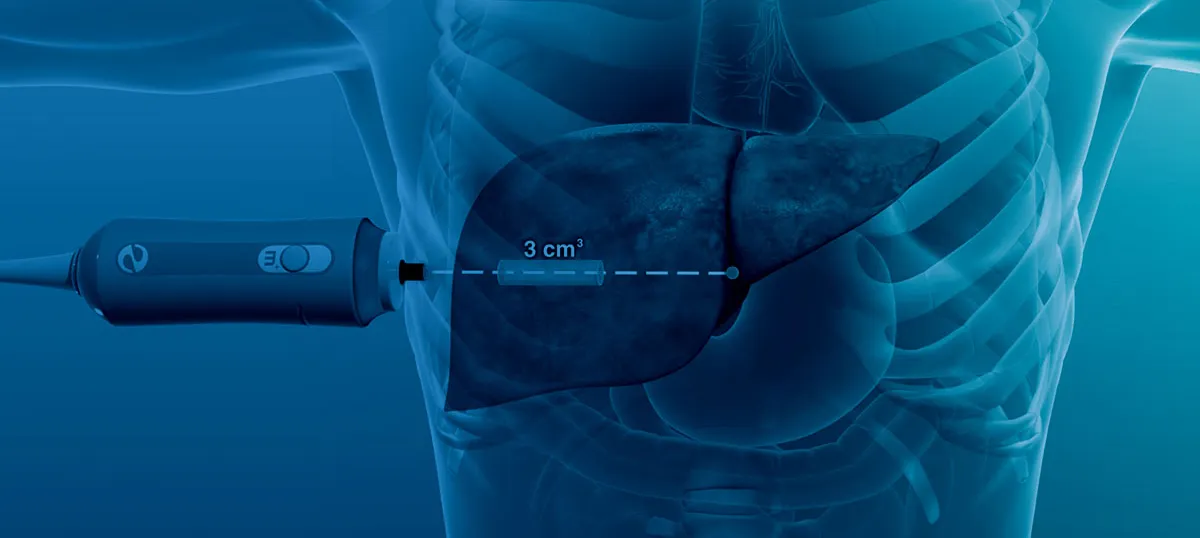
Fatty liver disease and other chronic liver conditions may progress without obvious symptoms. If your blood tests or abdominal ultrasound show possible liver abnormalities, your doctor may recommend a FibroScan to assess liver stiffness and, with suitable equipment, estimate fat accumulation in the liver.
FibroScan in Faridabad is a non-invasive test that helps evaluate liver health without a needle or surgical procedure. Dr. Ram Chandra Soni, MBBS, MD (Medicine), DM (Gastroenterology), is Chairman – Gastroenterology & Hepatology at Accord Superspeciality Hospital, Faridabad. He evaluates liver and digestive disorders and helps patients understand which investigations are appropriate for their condition.
FibroScan results are interpreted alongside medical history, blood tests, imaging, and other clinical findings. The test can provide valuable information, but it does not independently diagnose every liver disease.
FibroScan is a specialised examination that uses transient elastography to assess the liver. It measures how quickly a mechanical wave travels through liver tissue, providing an estimate of liver stiffness.
Depending on the device and measurement available, it can also estimate liver fat using a parameter known as the controlled attenuation parameter (CAP).
The test provides two important types of information:
FibroScan is painless, does not usually require needles, and generally takes only a short time to perform.
A gastroenterologist may recommend FibroScan when there is a reason to assess liver fat, stiffness, or possible fibrosis.
Fatty liver occurs when excess fat accumulates in liver cells. It may be associated with obesity, diabetes, high cholesterol, metabolic conditions, or alcohol use.
FibroScan can help estimate liver fat and assess stiffness in suitable patients. These findings may help the doctor determine whether additional evaluation or closer monitoring is needed.
Read more about Fatty Liver Disease: Symptoms, Causes, Stages and Treatment Options.
Long-standing liver inflammation can cause scar tissue to develop. FibroScan helps estimate liver stiffness and may assist in assessing the likelihood of fibrosis.
The results can help guide further investigations and follow-up, although stiffness does not always correspond directly to the amount of permanent scarring.
Patients with chronic hepatitis B or hepatitis C may need assessment for liver fibrosis as part of their ongoing care. FibroScan can provide useful information about liver stiffness alongside blood tests and other investigations.
Your doctor may recommend repeat FibroScan examinations to monitor changes in liver stiffness or fat measurements over time.
Repeat testing should be based on your diagnosis, previous results, treatment plan, and clinical needs.
These tests provide different types of information and may be used together.
FibroScan: Estimates liver stiffness and, when available, liver fat. It is non-invasive and does not use a needle.
Abdominal ultrasound: Produces images of the liver and nearby abdominal organs. It can identify features suggestive of fatty liver and structural abnormalities but does not directly measure liver stiffness in the same way as FibroScan.
Liver blood tests: Measure substances such as liver enzymes and bilirubin. They help assess liver injury and function, but normal results do not always exclude significant fibrosis.
Liver biopsy: Uses a needle to collect a small tissue sample for microscopic examination. It may be required when the diagnosis remains uncertain or more detailed tissue assessment is necessary.
FibroScan may reduce the need for biopsy in selected patients, but it cannot replace biopsy in every situation.
Your doctor may consider FibroScan if you have:
Not everyone with fatty liver or abnormal liver enzymes needs FibroScan. The decision depends on your medical history, initial test results, and whether the additional information is likely to affect your care.
Liver stiffness can be influenced by factors other than fibrosis, including active liver inflammation, bile duct obstruction, and liver congestion. Recent food intake may also affect measurements.
Severe obesity, fluid around the liver, and technical limitations can affect whether reliable measurements can be obtained.
Your doctor will interpret the findings in context rather than relying on a single number to determine the severity of liver disease.
Preparation depends on the device used and the facility’s protocol.
Confirm the fasting requirement when booking, particularly if you have diabetes or take medicines that must be coordinated with meals.
FibroScan is usually performed in an outpatient setting.
The examination is generally painless. You may feel a light tapping sensation from the probe, but needles and incisions are not involved.
The measurement itself commonly takes around 5–15 minutes, although the full appointment may take longer.
Liver stiffness is generally reported in kilopascals (kPa). Higher values may indicate a greater likelihood of fibrosis, but interpretation depends on the underlying liver condition, the reliability of the measurements, and other clinical findings.
There is no single cutoff that applies to every patient and every liver disease.
When the device provides a controlled attenuation parameter (CAP), the result is generally reported in decibels per metre (dB/m). It helps estimate the degree of liver fat.
CAP does not measure liver scarring, and neither measurement alone confirms every possible liver condition.
Your gastroenterologist will consider these findings alongside blood tests, medical history, ultrasound or other imaging, and the need for further evaluation.
Learn more about Dr. Ram Chandra Soni.
If you have fatty liver, persistent abnormalities in liver blood tests, chronic hepatitis, or a previous diagnosis of liver disease, consult Dr. Ram Chandra Soni to discuss whether FibroScan is appropriate for you.
Appointment: +91 98114 46141 | 24×7 Emergency: +91 88005 01960
Hospital: Accord Superspeciality Hospital, Sector 86, Greater Faridabad
Clinic: SCO 91, Sector 17, near Indian Bank, HUDA Market, Faridabad
Website: www.drramchandrasoni.in
FibroScan estimates liver stiffness to help assess fibrosis and may estimate liver fat, depending on the device. It is commonly used in evaluating fatty liver and selected chronic liver diseases.
No. It is generally painless and non-invasive. A probe is placed against the skin, and you may feel a light tapping sensation during measurement.
Fasting is commonly required for at least 2–3 hours, but instructions vary. Confirm the exact requirement with the facility performing your test.
The measurement generally takes around 5–15 minutes. The full appointment may take longer.
It can estimate liver fat when the device provides an appropriate fat measurement, such as CAP. The findings must be interpreted alongside clinical information and other tests.
FibroScan can help assess the likelihood of advanced fibrosis or cirrhosis, but it cannot independently confirm every case. Your doctor will consider the results alongside other findings.
They serve different purposes. Ultrasound provides images of the liver and surrounding organs, while FibroScan estimates liver stiffness and may assess liver fat. A doctor may recommend either or both.
No. Testing depends on risk factors, blood tests, imaging findings, and whether assessing fibrosis would influence management. Your gastroenterologist can help determine whether it is appropriate.
for FibroScan
From endoscopy and colonoscopy to FibroScan, ERCP and advanced gastrointestinal procedures, we offer expert diagnosis and personalized treatment for a wide range of digestive disorders.
Experience personalized medical attention and compassionate care. Book your appointment today and take the first step toward better health.
© 2026. Dr. Rama Chandra Soni.All rights Reserved.
Built By: Shivafeb17 | Codenbrand
 WhatsApp Us