

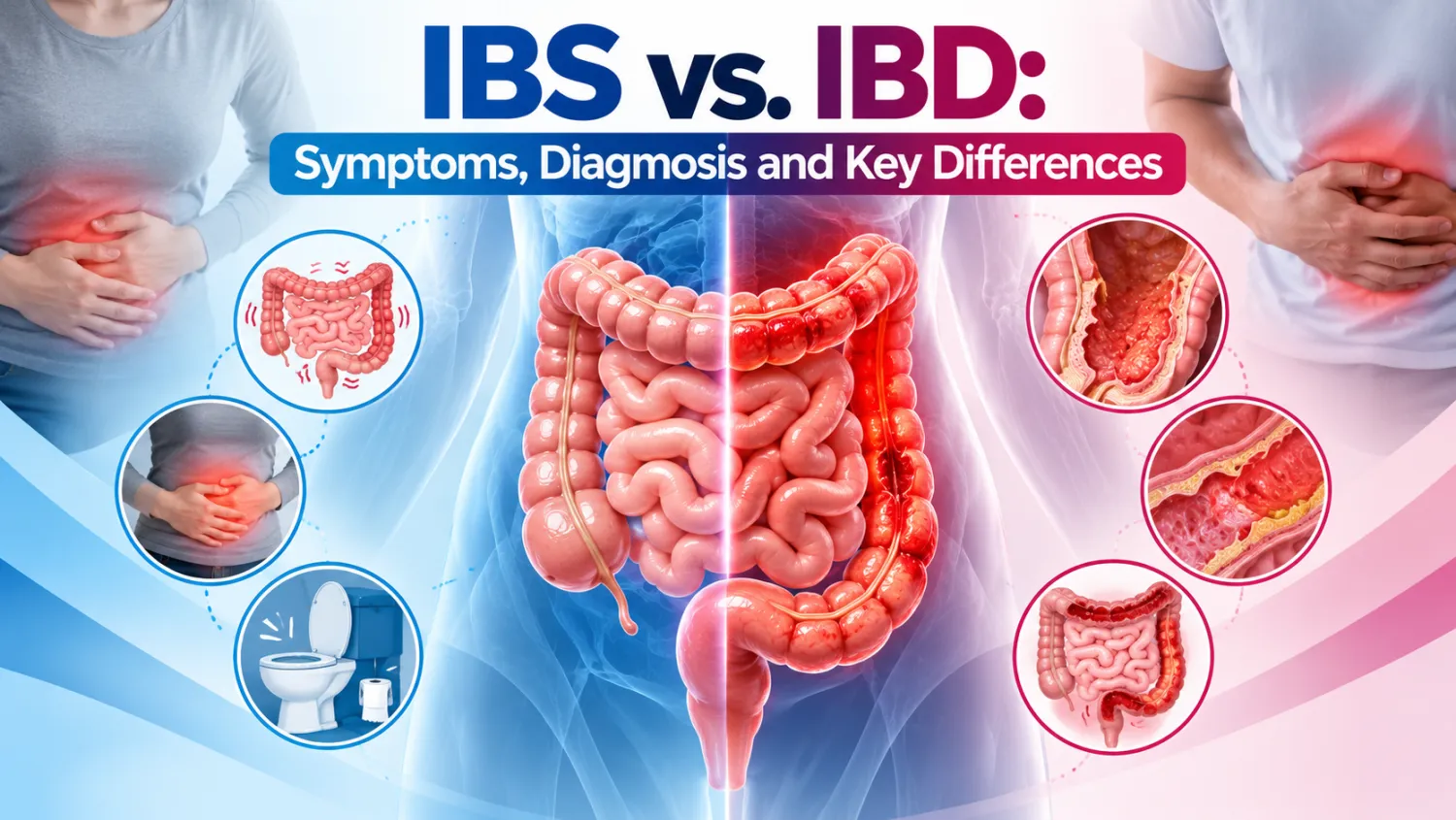
Irritable bowel syndrome (IBS) and inflammatory bowel disease (IBD) sound alike and can cause similar symptoms, but they are very different conditions. IBS is a disorder of how the gut works and feels. It causes symptoms without visible damage to the bowel. IBD is a group of chronic diseases in which the immune system causes inflammation and damage in the digestive tract. The two need different tests and different treatment, and IBD needs more careful follow-up.
This guide explains the main differences, how doctors tell them apart, and which symptoms should be checked promptly.
What is IBS?
IBS is a common long-term condition of the gut-brain interaction. The bowel looks normal on scans and scopes, yet it behaves abnormally: it may be more sensitive to normal sensations, or move too fast or too slowly.
Doctors usually diagnose IBS using the Rome IV criteria: recurring abdominal pain, on average at least one day a week over the last three months, linked to bowel movements or to a change in how often or in what form stool is passed, with symptoms starting at least six months earlier. [1] It is usually divided into types:
- IBS with constipation (IBS-C)
- IBS with diarrhoea (IBS-D)
- Mixed (IBS-M), with both patterns
IBS can be disruptive and tiring, but it does not cause inflammation or ulcers, does not lead to bowel cancer and does not turn into IBD.
What is IBD?
IBD is the umbrella term for two main conditions:
- Ulcerative colitis (UC): inflammation of the lining of the large intestine, starting in the rectum and spreading upwards without gaps.
- Crohn’s disease: inflammation that can affect any part of the digestive tract, from mouth to anus, often in patches and through the full thickness of the bowel wall. It can cause narrowing (strictures), abscesses and fistulas.
IBD is a lifelong condition with periods of flare and remission. Untreated inflammation can damage the bowel, cause anaemia and malnutrition and, in some people, require surgery. It can also affect joints, skin, eyes and the liver.
IBS vs IBD at a glance
|
|
IBS |
IBD (ulcerative colitis, Crohn’s disease) |
|---|---|---|
|
What it is |
Functional disorder; the gut looks normal |
Chronic immune-mediated inflammation with visible damage |
|
Typical symptoms |
Cramping pain, bloating, constipation, diarrhoea or both; relief often after passing stool |
Persistent diarrhoea, often with blood or mucus; urgency; pain; tiredness |
|
Blood in stool |
Not a feature of IBS |
Common, especially in ulcerative colitis |
|
Weight loss |
Not expected |
Often present |
|
Waking at night with symptoms |
Unusual |
Common |
|
Anaemia or raised inflammation markers |
No |
Often |
|
Effect on other organs |
No |
Possible: joints, skin, eyes, liver |
|
Scope findings |
Normal |
Inflammation, ulcers; biopsies confirm |
|
Risk of complications |
Not associated with bowel damage or cancer |
Strictures, fistulas, bleeding; higher colorectal cancer risk after many years of colitis |
|
Treatment focus |
Symptom control |
Control inflammation and prevent damage |
This table describes typical patterns. Individual symptoms overlap, and some people with IBD also have IBS-type symptoms while their inflammation is controlled.
Symptoms that overlap, and symptoms that point to IBD
Both conditions can cause abdominal pain, loose stools and urgency. This is why self-diagnosis is unreliable.
Warning (“red flag”) features that call for prompt medical evaluation
- Blood in stool or black stools
- Unintended weight loss
- Diarrhoea that wakes you from sleep
- Anaemia or persistent tiredness without another cause
- Fever, or night sweats
- Persistent vomiting or severe, constant abdominal pain
- New bowel symptoms after age 50
- A family history of IBD, coeliac disease or colorectal cancer
- Joint pain, mouth ulcers, eye redness or skin lesions along with bowel symptoms
- Pain or discharge around the anus, which can be a feature of Crohn’s disease
These features do not prove IBD. They mean IBS should not be assumed until other causes have been looked for.
How are they diagnosed?
IBS: a positive diagnosis, with limited testing
IBS is diagnosed from your symptom pattern, an examination and a small number of tests that exclude other conditions, usually when there are no warning features. [2] Common tests include:
- Blood count and inflammation markers (CRP)
- Coeliac disease blood test, because coeliac disease can mimic IBS
- Faecal calprotectin, a stool test that detects gut inflammation. A normal result makes IBD unlikely.
- Stool tests for infection when diarrhoea is prominent
- Colonoscopy in older adults, in those with warning features or when symptoms do not fit
IBD: tests that show inflammation
Suspected IBD is usually evaluated with:
- Blood tests: haemoglobin, iron stores, CRP, albumin
- Stool tests: faecal calprotectin and tests to exclude infection
- Colonoscopy with biopsies, the key test, which shows inflammation and allows tissue examination. The doctor may also look at the last part of the small bowel.
- Upper GI endoscopy, when the upper gut may be involved
- Imaging of the small bowel, such as MR or CT enterography, or capsule endoscopy in selected people, to assess Crohn’s disease
In India, one diagnosis is particularly important to consider: intestinal tuberculosis can look very similar to Crohn’s disease. Treatments are completely different, and steroids or immune-suppressing drugs can be harmful if TB is missed, so careful testing is essential.
Treatment: different goals
IBS treatment
The aim is to reduce symptoms and improve daily life. Doctors usually combine:
- Education and reassurance once serious disease has been reasonably excluded
- Diet changes: regular meals, identifying personal triggers, adjusting fibre and, in some people, a supervised low-FODMAP diet. This should be done with a dietitian, not as a long-term self-imposed restriction.
- Physical activity and sleep, and stress management
- Gut-directed psychological therapies, such as cognitive behavioural therapy or gut-directed hypnotherapy, which have good evidence in IBS
- Medicines matched to your type of IBS, such as antispasmodics, medicines for constipation or diarrhoea, or low-dose neuromodulators. The choice and dose depend on your symptoms and should be decided by your doctor.
IBD treatment
The aim is to control inflammation, achieve remission, heal the bowel lining, prevent complications and keep you well. Treatment depends on the type, location and severity of disease. Options include anti-inflammatory medicines, short courses of steroids for flares, immune-modulating medicines, biologic and other advanced therapies, nutrition support and, in some people, surgery. Before some of these medicines, doctors check for tuberculosis and hepatitis B, which is particularly relevant in India. People with IBD also need vaccination review, stopping smoking (which worsens Crohn’s disease), and regular long-term follow-up, including colonoscopy surveillance for those with long-standing colitis.
Do not start or stop IBD medicines on your own, and do not use steroids without medical supervision.
When to see a gastroenterologist
Book a consultation if:
- Bowel symptoms have lasted more than a few weeks or keep returning
- You have any warning feature listed above
- Symptoms are affecting your work, sleep, travel or social life
- You have been told you have IBS, but your symptoms are changing or are not improving with treatment
- You are over 45 to 50 with new bowel symptoms
Seek urgent care for heavy bloody diarrhoea, fever with severe abdominal pain, a swollen and tender abdomen, repeated vomiting, signs of dehydration, or inability to pass stool or gas.
IBS and IBD assessm
ent in Faridabad
If you are looking for a gastroenterologist in Faridabad to sort out ongoing bowel symptoms, Dr. Ram Chandra Soni is a gastroenterologist and hepatologist (MBBS, MD, DM in Gastroenterology) and Chairman of Gastroenterology & Hepatology at Accord Superspeciality Hospital, Faridabad, according to his profile. His profile lists diagnostic and therapeutic endoscopy, colonoscopy and enteroscopy among his areas of work. You can find more on the services page.
Bring any previous stool, blood and colonoscopy reports, along with a short diary of your bowel habits, food triggers and any weight change.
Conclusion
IBS is a common disorder of gut function, and IBD is a chronic inflammatory disease that damages the bowel. They can feel alike, which is why symptoms such as bleeding, weight loss, night-time diarrhoea or anaemia should always lead to a medical assessment. If you are not sure which one fits your symptoms, you can book a consultation.
This article is for general education and does not replace advice from your own doctor. It must be reviewed and approved by Dr. Soni or a qualified medical reviewer before publication.
Frequently asked questions
Can IBS turn into IBD?
No. IBS does not become IBD, and it does not damage the bowel. However, some people with symptoms labelled as IBS are later found to have IBD, which is why persistent or changing symptoms should be re-evaluated.
Is blood in the stool a sign of IBS or IBD?
Blood in stool is not caused by IBS. It can come from piles, fissures, infection, IBD or colorectal conditions, so it should always be assessed, especially if it persists or comes with other symptoms.
Can a person have IBS and IBD together?
Yes. Some people with IBD continue to have IBS-type symptoms, such as bloating or pain, even when inflammation is controlled. This needs a doctor to separate the causes, because the treatment differs.
What is faecal calprotectin?
It is a stool test that measures a protein released by inflammation in the gut. A normal level makes IBD unlikely, while a raised level suggests inflammation and usually leads to a colonoscopy.
Does stress cause IBS or IBD?
Stress can make IBS symptoms worse and can trigger flare-ups in some people with IBD, but it is not the cause of either condition. Managing stress is a helpful part of care, not a replacement for medical treatment.
Can IBD be cured?
IBD is a long-term condition without a cure at present, but many people reach long periods of remission with treatment. Ulcerative colitis can sometimes be treated surgically by removing the colon, which is a major decision made with a specialist.
Is a special diet necessary for IBS or IBD?
There is no single diet for everyone. Some people with IBS benefit from a supervised low-FODMAP diet. In IBD, diet supports nutrition and may be adjusted during flares or strictures. A dietitian can help, and restrictive diets should not be started without guidance.
 WhatsApp Us