


Almost every day in my OPD, someone sits down and says, “Doctor, it’s just acidity.” They have usually been saying it for months. They have tried the antacid syrup, the tablet the chemist suggested and a few remedies from relatives, and the burning keeps coming back.
Often it really is just acidity. But sometimes that burning in the chest or upper abdomen is the only warning an ulcer, an infection or a food-pipe problem gives before it turns into something harder to treat. This article explains how acidity, ulcers and H. pylori are connected, and how to tell ordinary heartburn from the kind that needs a proper check.
How acidity, heartburn, ulcers and H. pylori are connected
These four words are often used as if they meant the same thing. They do not, and knowing the difference makes it much easier to decide when to worry.
Acidity is the everyday word for acid in the wrong place or in the wrong amount. Your stomach makes strong hydrochloric acid to digest food and kill germs. The stomach is built to cope with it. The food pipe is not. I have covered this in more detail in my guide to acidity: causes, symptoms and treatment.
Heartburn is the symptom: a burning feeling behind the breastbone that may rise towards the throat, usually after meals or when you lie down. It is what you feel when acid touches the lining of the food pipe. You will find more in heartburn: causes, triggers and when to see a doctor.
A peptic ulcer is an open sore in the lining of the stomach or the first part of the small intestine, called the duodenum. I explain it separately in peptic ulcer: symptoms, causes and treatment.
H. pylori (Helicobacter pylori) is a bacterium that lives in the stomach lining. Along with regular use of painkillers such as diclofenac and ibuprofen, it is one of the two leading causes of ulcers. My article on H. pylori infection, testing and treatment goes deeper.
Put together, the story often runs like this. An infection or a painkiller damages the protective lining. The damaged area becomes sore. Acid irritates it further, and you feel “acidity”. If you only treat the burning, the cause stays untouched.
When heartburn is just heartburn
An occasional burn after a heavy, oily meal, a late dinner, a week of festival sweets or too many cups of tea on an empty stomach is very common and usually harmless. The pattern is reassuring when there is a clear trigger, it settles quickly with simple measures, and nothing else is going on.
The picture changes when “occasionally” becomes “regularly”. Heartburn that shows up twice a week or more, wakes you at night or needs a tablet every other day is no longer a diet problem. It may be gastro-oesophageal reflux disease (GERD), and it deserves assessment. I have explained the difference in Acidity, GERD and Acid Reflux: When Should You See a Gastroenterologist?
Signs that it may be more than heartburn
Some symptoms should never be put down to acidity without a proper check. Please do not wait if you notice any of these:
- Pain or difficulty while swallowing, or food that feels stuck
- Vomiting blood, or vomit that looks like coffee grounds
- Black, tar-like stools, or blood in the stool
- Weight loss that you cannot explain
- Repeated vomiting, or feeling full after only a few bites
- Looking pale, feeling unusually tired, or a low haemoglobin on a blood test
- New digestive symptoms starting after the age of 45 to 50
- A family history of stomach or food-pipe cancer
- Pain that wakes you at night or does not respond to medicines
- Burning that returns every time you stop your tablets, which I discuss in why your acidity keeps coming back despite taking medicines
One more point, because it can save a life. Chest discomfort is not always the stomach. If chest pain comes with sweating, breathlessness, a heavy or squeezing feeling, or pain spreading to the left arm, jaw or back, treat it as a possible heart attack and go to an emergency department at once. Do not wait to see whether an antacid helps.
Peptic ulcers: the quiet cause behind “stubborn acidity”
Ulcer pain is usually a gnawing or burning ache in the upper middle abdomen, somewhere between the breastbone and the navel. A duodenal ulcer often hurts when the stomach is empty, between meals or in the early hours of the night, and a few bites of food may bring brief relief. A stomach ulcer may hurt soon after eating, and some patients begin to avoid food and lose weight.
Not everyone follows this pattern. Older adults and people who take painkillers regularly sometimes feel nothing until the ulcer bleeds. Bleeding can show up as black stools, vomiting blood or sudden dizziness. A sudden, severe, rigid-belly pain can mean a perforation. Both are emergencies.
The reassuring part is that most ulcers heal well once the cause is found and treated. The harm comes from guessing for months.
H. pylori: the infection many people carry without knowing
H. pylori is very common in India. Studies suggest that more than half of adults carry it, usually picked up in childhood through contaminated food or water, or through close contact in crowded households. Many people never have a single symptom.
In others the bacterium causes long-standing gastritis and ulcers, and over many years it can raise the risk of stomach cancer in a small minority. Its symptoms are vague: upper abdominal discomfort, bloating, burping, nausea, feeling full early. They look exactly like ordinary acidity, which is why testing matters.
How we find the cause
I start by listening. How long has it been going on? Is it related to meals? Do you take painkillers, steroids or blood thinners? Do you smoke or drink alcohol? Has your weight changed, or have your stools? The answers often point to the diagnosis before any test is done.
After that, depending on the story, I may advise:
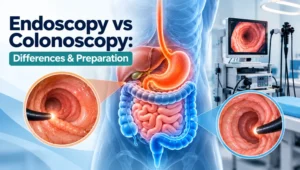
- Upper GI endoscopy. A thin, flexible tube with a camera lets us look directly at the food pipe, stomach and duodenum, see ulcers or inflammation, and take tiny biopsies, including a test for H. pylori. It is a short day-care procedure, usually done with sedation. You can read what to expect on our endoscopy page.
- A urea breath test or stool antigen test to detect H. pylori without endoscopy. These need preparation, usually stopping acid-reducing tablets for about two weeks and antibiotics for about four weeks beforehand, so please ask before you stop anything.
- Blood tests, mainly to look for anaemia.
Not everyone with acidity needs an endoscopy. People with warning signs, or with symptoms that do not settle, do. I describe how I decide in 7 questions I ask every patient with persistent acidity before recommending an endoscopy.
How these conditions are treated
Treatment follows the cause. Acid-reducing medicines, mainly proton pump inhibitors, let the lining heal. If H. pylori is present, the usual treatment is a combination of antibiotics plus an acid-reducing medicine, taken for about 14 days, followed by a test at least four weeks later to confirm the bacteria are gone. If painkillers caused the ulcer, we stop or replace them wherever possible and protect the stomach.
Two requests from me. Finish the full course even if you feel better after a few days. And please avoid taking antibiotics or long courses of acid-reducing tablets on your own, because incomplete treatment makes the bacteria harder to clear later.
What you can do at home meanwhile
- Eat smaller meals and keep a gap of two to three hours between dinner and bedtime
- Raise the head end of your bed by a few inches if night-time burning troubles you
- Notice your own triggers: spicy or fried food, tea or coffee on an empty stomach, fizzy drinks and large late meals are common ones
- Stop smoking and tobacco, and cut back on alcohol
- Do not use painkillers regularly without medical advice
- Work towards a healthy weight if you are carrying extra around the waist
These steps help, but they do not replace a diagnosis when warning symptoms are present.
When to see a gastroenterologist
Please book a consultation if heartburn lasts more than two weeks despite medicines, happens most weeks, keeps returning when you stop treatment, or comes with any of the warning signs above. A short assessment now is far easier than treating a complication later.
To book an appointment, call +91 98114 46141. For emergencies, the 24×7 line is +91 88005 01960.
This article is for general awareness and does not replace a personal medical consultation.






 WhatsApp Us