

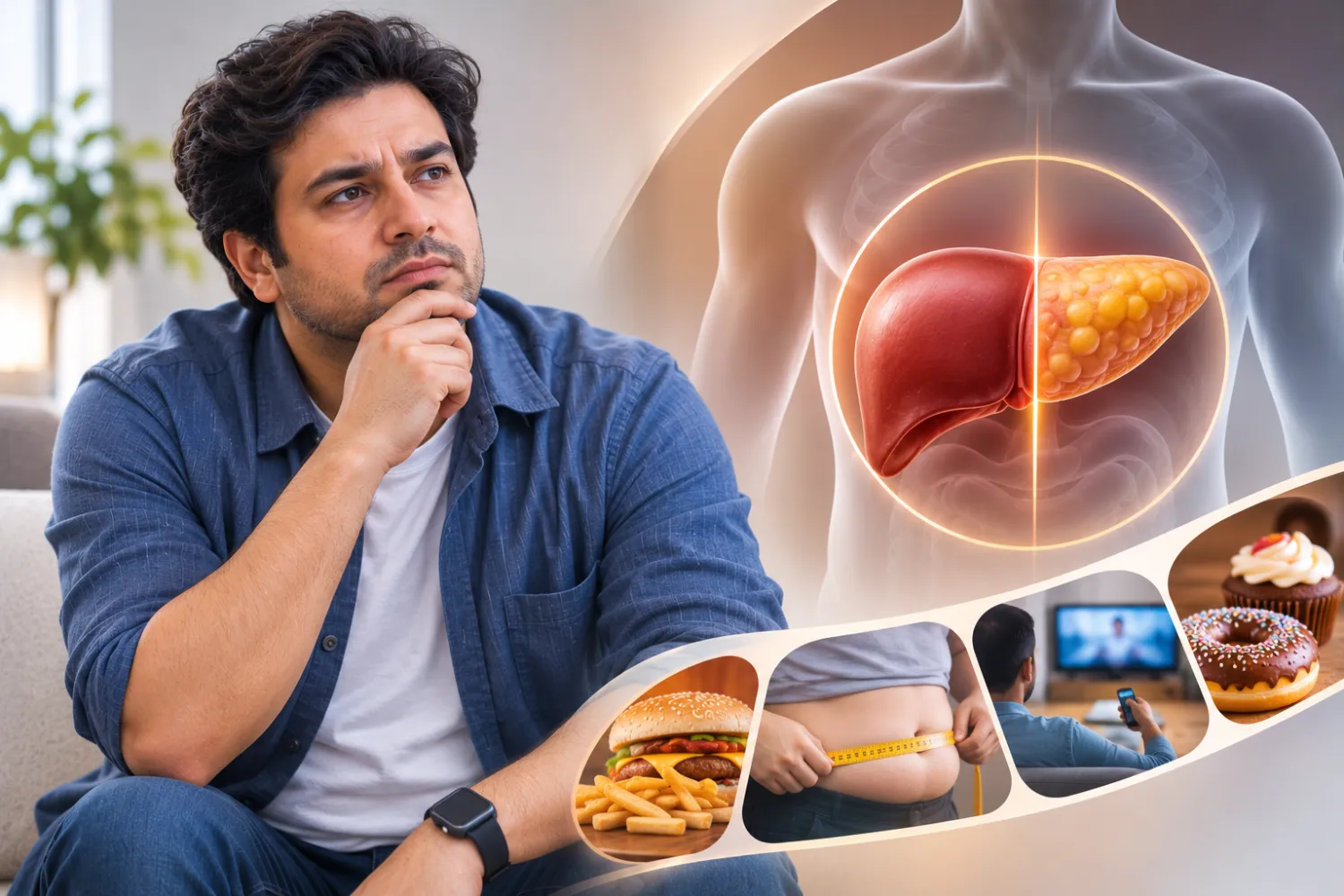
A line saying “fatty liver, grade 1” is one of the most common surprises on a routine ultrasound report. The advice that usually follows is to cut down on oily food and exercise more. Most people go home without learning the one thing that really matters: has the fat caused any scarring in the liver?
That is the question a FibroScan answers. This article explains who should have one, what it involves, and how to make sense of the numbers. If you want the basics of fatty liver first, we have already covered symptoms, causes, stages and treatment and what to do after a fatty liver finding on ultrasound.
Why this matters more than it used to
Fatty liver is no longer a rare finding. An AIIMS-led review found it in about 38.6 percent of Indian adults and 35.4 percent of children, according to recent news coverage. Another study reported significant liver scarring in about one in four people with type 2 diabetes. The disease is now called metabolic dysfunction-associated steatotic liver disease (MASLD), a name that points to its link with weight, blood sugar and cholesterol.
Most people with fatty liver never develop serious liver disease. But a minority do, and the problem is that nothing warns you. There is usually no pain, no yellow eyes, no obvious symptom until the liver is badly scarred.
Fat is not the same as damage
It helps to think of fatty liver as a spectrum:
- Simple fat. Extra fat in the liver cells with little or no inflammation. Often reversible.
- Fat with inflammation. The liver is irritated and cells are being injured.
- Fibrosis. Scar tissue starts to form. Early fibrosis can still improve with treatment.
- Cirrhosis. Widespread scarring that changes the liver’s structure and function. This is where complications such as fluid in the abdomen, bleeding from swollen veins and liver cancer risk appear.
Treatment decisions depend on where you are on this line, and that is exactly what an ultrasound cannot tell you.
Why an ultrasound is not enough
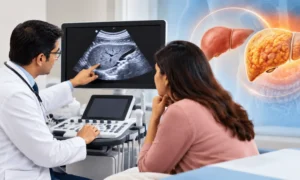
Ultrasound is a good way to spot fat in the liver, but it does not measure scarring. Routine blood tests can also mislead. Liver enzymes (SGOT and SGPT) are normal in many people who already have fibrosis, so a normal report does not clear you.
A FibroScan fills that gap. It estimates how stiff the liver is, and scarred liver tissue is stiffer than healthy tissue.
What is a FibroScan?
FibroScan is a painless, non-invasive test based on transient elastography. You lie on your back with your right arm raised. A probe is placed on the skin between the ribs on the right side, and it sends a gentle pulse into the liver. The machine measures how fast the pulse travels. The whole test takes about 10 minutes, with no needles, no sedation and no recovery time.
You get two numbers:
- Liver stiffness (in kPa). A measure of scarring.
- CAP score (in dB/m). A measure of how much fat is in the liver.
Dr. Soni offers FibroScan in Faridabad, and the result is reviewed together with your history and blood tests rather than on its own.
Who should consider a FibroScan?
It is worth discussing if you have fatty liver on ultrasound and any of the following:
- Type 2 diabetes or prediabetes
- Obesity, a large waistline, high blood pressure or high triglycerides
- Persistently raised liver enzymes
- Regular alcohol intake
- A family history of liver disease or cirrhosis
- Long-term use of medicines that can affect the liver
- Chronic hepatitis B or C
People with a normal weight can have fatty liver too, particularly if they carry fat around the abdomen, so do not rule yourself out because you look thin.
How to prepare
Preparation is simple. You will usually be asked to avoid food and drink for about three hours before the scan, because a recent meal can push the stiffness reading up. Wear loose clothing, and tell the team if you have a pacemaker or other implanted device, or if you have fluid in your abdomen.
Reading your results
Cut-offs differ slightly between guidelines and machines, so please treat these ranges as a rough guide, not a diagnosis:
- Stiffness below roughly 8 kPa. Significant scarring is unlikely.
- Roughly 8 to 12 kPa. A grey zone. Further assessment is usually needed.
- Above roughly 12 kPa. Raises concern for advanced fibrosis. Follow-up with a liver specialist matters.
A high CAP score tells us there is a lot of fat but says little about damage, so it is the stiffness number that drives decisions.
What FibroScan cannot do
No test is perfect. Obesity or narrow gaps between ribs can make readings difficult. A recent heavy meal, active liver inflammation, heart failure or blocked bile ducts can push stiffness upward. That is why doctors look at the whole picture, often adding a simple blood-based score such as FIB-4, and sometimes further imaging or other tests when the results are borderline.
What happens after the result?
If scarring is unlikely, the plan is to protect what you have: weight, diet, exercise and blood sugar control. Many doctors repeat the scan after a year or two, sooner if your risk factors change.
If the result is in the middle, we look deeper, check for other causes of liver disease, and tighten control of diabetes and cholesterol.
If advanced fibrosis or cirrhosis is suspected, you will need regular specialist follow-up, screening for liver cancer and for swollen veins in the food pipe, vaccination against hepatitis A and B, and careful use of medicines.
What actually helps the liver
The most reliable treatment for fatty liver remains lifestyle change, and it works better than most people expect:
- Lose 5 to 10 percent of your body weight if you are overweight. This alone can reduce liver fat and, in some people, inflammation and early scarring.
- Eat more vegetables, whole grains, pulses and nuts, and cut back on sugary drinks, sweets, refined flour and deep-fried snacks.
- Move for 150 minutes a week or more. Brisk walking counts.
- Control diabetes and cholesterol with your doctor’s guidance.
- Limit or avoid alcohol, especially if fibrosis is present.
- Avoid crash diets and unproven “liver detox” supplements. Rapid weight loss can worsen liver inflammation, and herbal products are not always safe for the liver.
A note for families
Children can have fatty liver too, particularly if they are overweight. If a child’s ultrasound shows fat in the liver, it is worth speaking to a doctor early. Habits formed at home, such as how much sugary food and screen time a child has, make a real difference.
The same weight and blood sugar problems that drive fatty liver also raise the risk of bowel cancer, which is one reason we encourage people not to ignore bowel symptoms either. Our article on blood in stool: piles or colorectal cancer explains when to get checked.
Talk to Dr. Soni
Dr. Ram Chandra Soni (MBBS, MD Medicine, DM Gastroenterology) is Chairman – Gastroenterology & Hepatology at Accord Superspeciality Hospital, Faridabad. You can book an appointment.
This article is for general information and does not replace medical advice. Please consult a doctor about your own symptoms and reports.
 WhatsApp Us